Dead Ends and High Prices: The Surprising Real Estate Economics of Cul-de-Sac Living
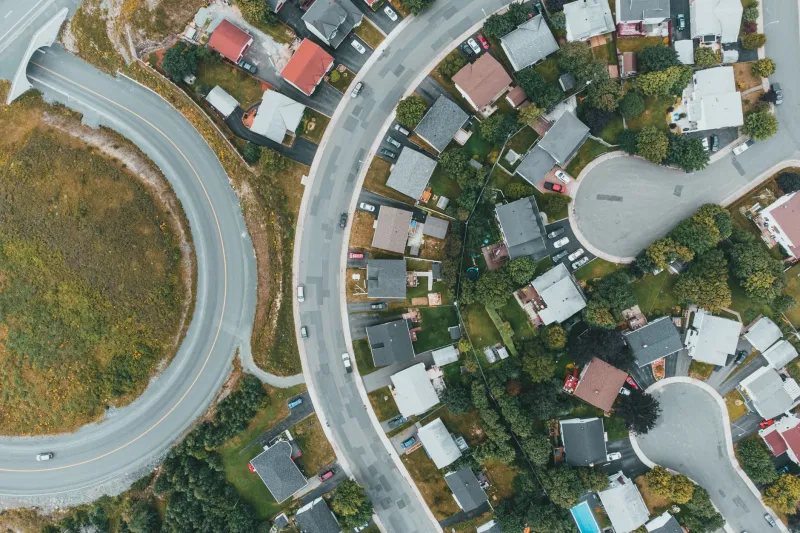
There is something quietly paradoxical about the cul-de-sac. By strict definition, it is a street that goes nowhere. It terminates. It offers no shortcuts, no throughput, no civic efficiency. And yet, in neighborhood after neighborhood across the United States, properties situated at or near these circular dead ends command prices that consistently outpace their counterparts on conventional through-streets. The question worth asking — particularly for buyers weighing their options in residential markets — is whether that premium is earned or imagined.
What the Data Actually Shows
Research on cul-de-sac valuations has produced results that are difficult to dismiss. Studies examining residential sales data across multiple American metro areas have found that homes on cul-de-sacs and low-traffic dead-end streets can sell for anywhere from three to fifteen percent more than structurally similar homes on through-streets, depending on the market. In family-oriented suburban neighborhoods, the gap tends to widen. In urban or transitional markets where walkability and access are prized, it can narrow considerably or disappear altogether.
The variability matters. A cul-de-sac premium is not a universal law — it is a contextual phenomenon. It reflects what a specific buyer pool in a specific community values at a specific moment. Understanding those variables is the work of serious market analysis, not casual assumption.
The Traffic Argument: Real Reduction, Real Value
The most defensible component of the cul-de-sac premium is the measurable reduction in vehicle traffic. A home on Cline Avenue, for example, sits on a through-street where cars pass with regularity — commuters, delivery vehicles, visitors to neighboring blocks, and the general circulation of a connected neighborhood. That is not a flaw; it is simply the nature of a street that serves a broader network.
A cul-de-sac, by contrast, carries only the traffic of its own residents and their guests. Studies in urban planning have confirmed that dead-end street configurations reduce total vehicle volume by as much as seventy to eighty percent compared to equivalent through-street segments. For households with young children or elderly family members, that reduction translates into something tangible: a quieter front yard, less noise, reduced exhaust exposure, and a street where children can play with less parental anxiety.
These are not trivial considerations. They represent a real and recurring quality-of-life benefit that many buyers are willing to pay to secure.
The Safety Perception: Documented or Constructed?
The perception that cul-de-sacs are safer — particularly for children — is deeply embedded in American suburban culture. Developers recognized this decades ago and deliberately incorporated cul-de-sac layouts into postwar subdivision designs as a marketing feature as much as an engineering one. That history is worth acknowledging.
Crime statistics offer a more nuanced picture. Some research suggests that cul-de-sac streets do experience lower rates of certain property crimes, partly because limited access means fewer unfamiliar vehicles and pedestrians passing through. There are fewer opportunities for the casual surveillance that precedes opportunistic theft. However, other analysts caution that the relationship between street configuration and crime is heavily mediated by neighborhood density, lighting, community engagement, and socioeconomic factors that have little to do with whether a street curves into a circle at its end.
The safety premium, then, is partly real and partly perception. Both matter in real estate. Buyers do not purchase based solely on actuarial data — they purchase based on how a property makes them feel. And if a cul-de-sac address reliably produces a sense of security and enclosure, that feeling has market value regardless of whether it is fully supported by the statistics.
The Social Dimension: Neighborhood Intimacy and Its Costs
Cul-de-sacs tend to foster a particular kind of neighbor relationship. The shared turnaround space, the visual enclosure, the absence of passing strangers — these elements create a micro-community within the larger neighborhood. Residents on cul-de-sacs often report higher rates of neighbor interaction, shared watching of children, and informal social bonding than residents on through-streets.
For some buyers, this is a significant draw. For others, it is a liability. The same proximity that produces community can produce friction. On a cul-de-sac, there is no escaping a difficult neighbor. The social pressure of a small, enclosed street can feel warm and supportive or claustrophobic, depending on the personalities involved and the dynamics that develop over time. Buyers who value anonymity and independence may find that the cul-de-sac premium purchases them something they never wanted.
What Gets Left Out of the Premium Conversation
Several structural drawbacks of cul-de-sac properties receive insufficient attention in the premium narrative. First, lots on cul-de-sacs are frequently pie-shaped — narrower at the street and wider at the rear — which can complicate landscaping, garage placement, and the usability of front yard space. Second, emergency vehicle access on cul-de-sacs, while generally adequate, can occasionally present complications during high-traffic situations or when multiple vehicles are parked in the turnaround area. Third, in climates with significant snowfall, cul-de-sac turnarounds can accumulate plowed snow in ways that temporarily restrict movement and reduce curb appeal during winter months.
None of these factors eliminates the case for cul-de-sac living, but they are worth factoring into any honest assessment of whether the premium is proportionate to the actual benefit received.
Through-Street Properties and the Case for Connectivity
It would be a mistake to frame this analysis as a simple verdict in favor of the cul-de-sac. Through-street properties carry their own advantages that are frequently undervalued in residential markets precisely because they are less emotionally resonant.
Connectivity — the ability to walk or drive to adjacent streets, parks, commercial areas, and transit stops without backtracking — has measurable value in a housing market increasingly attentive to walkability scores and access metrics. A home on a well-situated through-street may offer superior proximity to schools, retail corridors, and public transportation. In markets where younger buyers and downsizing retirees are dominant purchasing forces, that connectivity can command its own premium.
The cul-de-sac optimizes for enclosure. The through-street optimizes for access. Which configuration deserves the higher price depends entirely on what the buyer intends to do with their daily life.
The Verdict: Justified Premium or Market Psychology?
The honest answer is that the cul-de-sac premium reflects both genuine utility and psychological construction, and the proportions vary by buyer and market. The traffic reduction is real. The noise reduction is real. The social dynamics are real, for better and for worse. The safety perception is partly real and partly manufactured by decades of suburban marketing.
What this means practically is that buyers should resist accepting the cul-de-sac premium as an unexamined given. Before paying above-market value for a dead-end address, it is worth asking what specific benefits that configuration will deliver to your household's actual lifestyle — not the idealized suburban lifestyle that cul-de-sac imagery tends to evoke, but the specific rhythms of your family, your commute, your social preferences, and your long-term plans.
In real estate, the most expensive mistakes are rarely the ones made on faulty numbers. They are the ones made on unexamined assumptions about what a particular kind of address is supposed to mean.