Roots Run Deep: The Measurable Financial Case for Buying on a Tree-Canopied Street
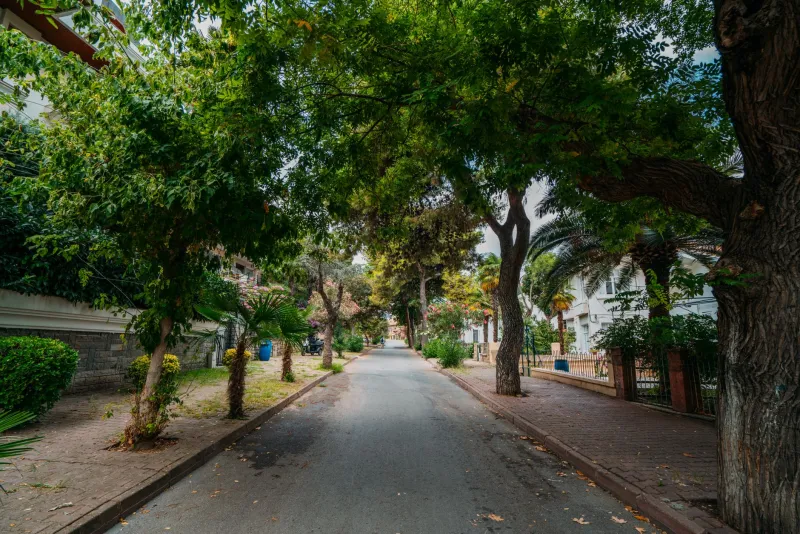
There is a particular quality of light that falls through a canopy of old-growth oaks on a summer afternoon—dappled, unhurried, and unmistakably residential. It is the kind of light that stops buyers in their tracks during a showing, the kind that makes a street feel settled rather than merely built. What is less often acknowledged is that this quality of light carries a dollar figure attached to it, one that appraisers and economists have been quietly documenting for decades.
On streets like Cline Avenue, where mature maples and oaks have had generations to establish their root systems and spread their canopies across the roadway, that premium is not incidental. It is structural.
What the Data Actually Shows
The relationship between tree cover and residential property values has been studied with increasing rigor since the 1990s, and the findings are remarkably consistent. Research from the USDA Forest Service has estimated that mature street trees can add between 3 and 15 percent to a home's market value, depending on species, canopy density, and the relative scarcity of such trees in the surrounding market. A study conducted by the University of Washington found that homes with significant tree cover sold for an average of 7 percent more than comparable homes without it—a figure that, in today's median-priced American housing market, can translate to tens of thousands of dollars.
More telling than the price differential, however, is the velocity differential. Properties on tree-lined streets tend to spend fewer days on the market. Buyer interest is activated earlier in the decision process, often before the prospective purchaser has even stepped inside the front door. The street itself performs as a pre-qualifying signal, communicating neighborhood permanence, owner investment, and long-term desirability before a single interior feature has been evaluated.
The Psychology Behind the Premium
To understand why trees command this kind of market response, it is worth examining what buyers are actually purchasing when they acquire a home on a canopied street. They are not simply buying square footage or lot dimensions. They are buying a sensory environment—a specific experience of arriving home, of sitting on a porch, of watching children play in a particular quality of afternoon shade.
This experiential dimension of residential real estate is notoriously difficult to price, yet buyers consistently demonstrate a willingness to pay for it. In behavioral economics, this is sometimes described as the "halo effect" of environmental amenity: the positive impression generated by mature landscaping extends to the buyer's assessment of the home's construction quality, the neighborhood's social cohesion, and even the perceived competence of local municipal governance. A well-canopied street signals, implicitly, that a community has been well-maintained over a long period of time.
This is not irrational sentiment. It reflects a genuine correlation. Neighborhoods with mature tree canopy typically are older, more established communities with longer histories of homeownership stability and civic investment. The trees are, in a meaningful sense, evidence of the neighborhood's track record.
Why New Construction Cannot Replicate This Asset
One of the more instructive exercises in residential real estate analysis is to compare two otherwise identical homes—same floor plan, same square footage, same school district—where one sits on a street with 60-year-old elms and the other on a street where the developer planted three-inch-caliper saplings at closing. The price gap between those two properties is not speculative. It is observable, and it widens over time.
Developer-planted trees, however well-intentioned, require decades to achieve the canopy density that creates the environmental and psychological effects buyers respond to. A newly constructed subdivision in the outer suburbs may offer every modern interior amenity, but it cannot manufacture the overhead architecture of a 70-foot oak. That asset is irreplaceable in the short term, and its scarcity in newer markets makes it all the more valuable in established ones.
This is one reason why buyers who prioritize long-term resale value are increasingly attentive to the age and character of street-level landscaping during their search process. The question is not only what the house looks like, but what the street looks like—and what it will still look like in fifteen years.
Environmental Utility as a Value Driver
Beyond aesthetics and psychology, mature trees deliver quantifiable environmental services that translate directly into household economics. A dense canopy reduces ambient temperatures on the street level by as much as 10 degrees Fahrenheit during summer months, according to research published by American Forests. This thermal buffering effect reduces cooling loads on residential HVAC systems, lowering utility costs in a manner that compounds annually over the life of ownership.
Additionally, established trees provide meaningful stormwater management, reducing surface runoff and the strain it places on municipal drainage infrastructure. In communities where aging stormwater systems generate periodic flooding concerns, the presence of mature tree root systems offers a form of passive mitigation that newer developments—with their impermeable surfaces and immature plantings—cannot replicate.
These environmental services are increasingly being recognized not just by buyers, but by municipal assessors and insurance underwriters who factor canopy density into neighborhood risk profiles.
Reading the Street Before You Make an Offer
For buyers currently evaluating properties, the practical implication of this analysis is straightforward: the landscaping visible from the curb is not cosmetic detail. It is a data point with direct bearing on both the current market value and the future appreciation trajectory of the home.
Before submitting an offer, it is worth asking several questions. How old is the canopy on this street? Are the trees on public right-of-way—meaning they are maintained by the municipality—or are they on private lots, where their future is contingent on individual owner decisions? Has the neighborhood historically invested in replacing trees lost to disease or storm damage? The answers to these questions sketch a picture of a street's long-term environmental character.
On streets where the canopy is dense, continuous, and municipally maintained, buyers are acquiring an asset whose value is both present and durable. On streets where the trees are young, sparse, or irregularly distributed, the environmental premium has not yet materialized—and may not for a generation.
The Street as a Long-Term Investment
Real estate analysis tends to focus on the structure: the roof, the foundation, the mechanical systems, the kitchen renovation. These are legitimate concerns. But the street on which a home sits is also an asset, one that depreciates or appreciates independently of the dwelling itself.
A tree-lined street is not a backdrop. It is infrastructure—biological, aesthetic, and economic infrastructure that took decades to build and cannot be quickly replaced. For buyers who understand this, the premium attached to properties on well-canopied streets is not a mystery. It is the market doing what markets do: pricing scarcity, permanence, and the things that genuinely cannot be replicated on a developer's timeline.
The oaks have been here longer than most of the houses. In a meaningful sense, they are the neighborhood's most patient—and most reliable—investment.